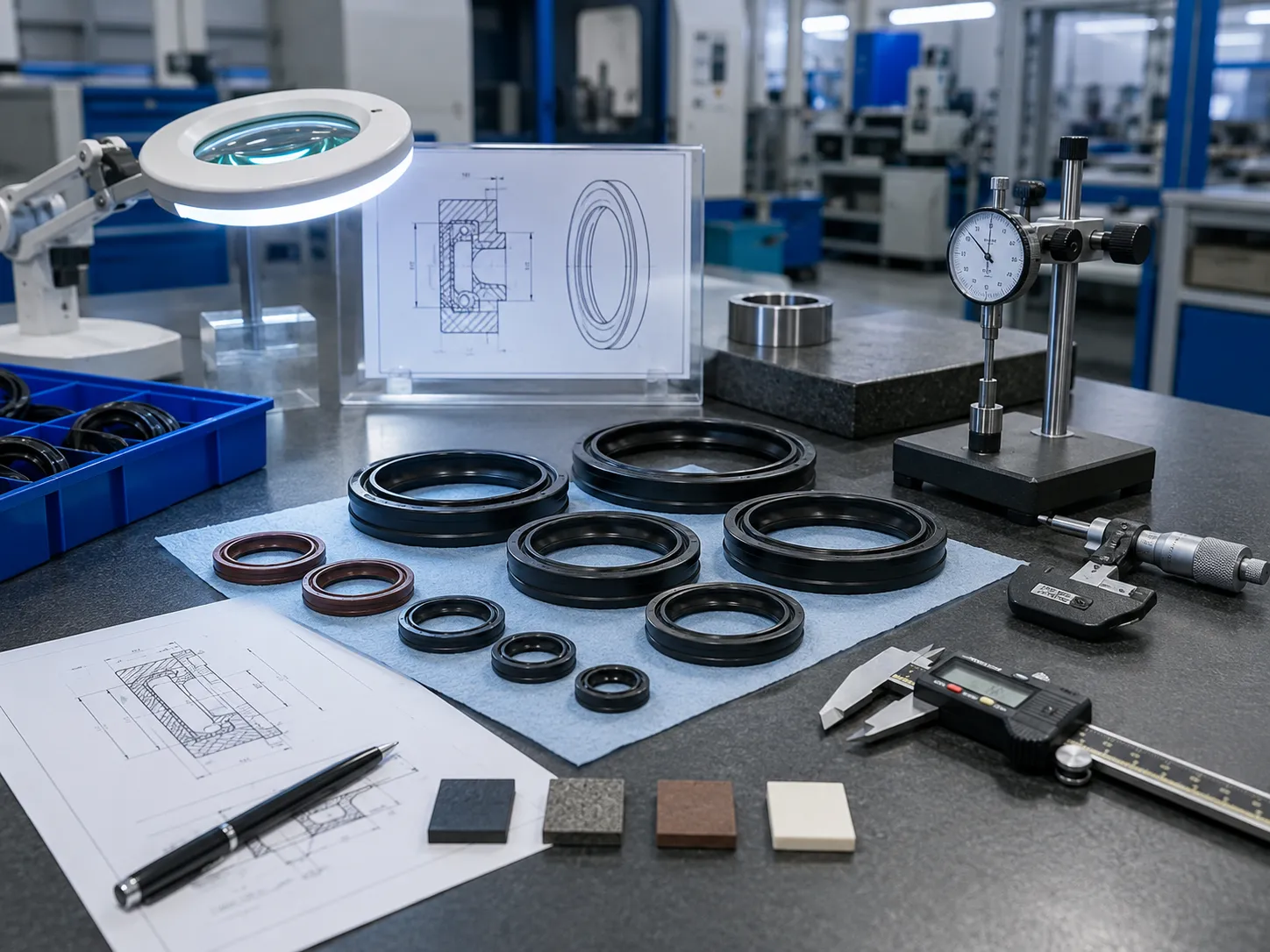
Finding a reliable oil seal supplier can be difficult when many products appear similar in photos, catalogs, and online listings. Two suppliers may offer the same size, such as 35 × 52 × 7 mm, but the actual sealing performance can vary significantly depending on material quality, lip design, spring condition, molding accuracy, metal case structure, shaft compatibility, and quality control.
A low unit price may look attractive at first, but an incorrect or inconsistent oil seal can create much higher costs later through oil leakage, repeat repairs, warranty claims, machine downtime, rejected shipments, or customer complaints.
The right supplier should be able to provide more than a product list. They should understand the application, confirm dimensions and material requirements, explain available seal structures, provide samples when needed, and communicate clearly about quality, lead time, packaging, and order requirements.
This guide explains how to evaluate an oil seal supplier before placing an order and what questions to ask before approving samples or production.
Why Supplier Selection Matters for Oil Seals
Oil seals are small components, but they are often installed in critical positions. They may be used in engines, transmissions, gearboxes, pumps, agricultural machinery, construction equipment, electric motors, hydraulic systems, and industrial rotating equipment.
When an oil seal fails, the problem may not remain limited to a small oil leak. A failed seal can lead to:
Loss of lubricant
Overheating
Shaft wear
Bearing damage
Belt contamination
Transmission fluid loss
Gearbox damage
Equipment downtime
Repeat maintenance
Customer complaints
For this reason, supplier selection should focus on technical suitability and consistency, not only on the lowest quoted price.
A reliable supplier helps reduce uncertainty before an order is placed. They should be able to confirm whether the requested seal is suitable for the shaft size, housing bore, fluid type, temperature, lip design, and operating environment.
Start With the Product Specification
Before comparing suppliers, define what you actually need.
An oil seal supplier can only provide an accurate recommendation if the application information is clear. A size alone is often not enough.
For example, a 35 × 52 × 7 mm seal could be supplied in different materials, lip structures, outer diameter designs, and pressure capabilities.
The basic specification should include:
Inner diameter, or ID
Outer diameter, or OD
Width
Seal type or lip structure
Material requirement
Shaft speed
Operating temperature
Fluid type
Pressure condition
Shaft rotation direction, if relevant
Shaft surface condition
Exposure to dust, water, mud, fuel, or chemicals
OEM part number, if available
Original sample or product photo
Application details
For example, a standard NBR SC oil seal may be suitable for a clean indoor gearbox, while an FKM TC oil seal may be more appropriate for a high-temperature engine or exposed outdoor application.
The more complete the information, the easier it is to compare supplier recommendations accurately.
Check Whether the Supplier Understands Oil Seal Structure
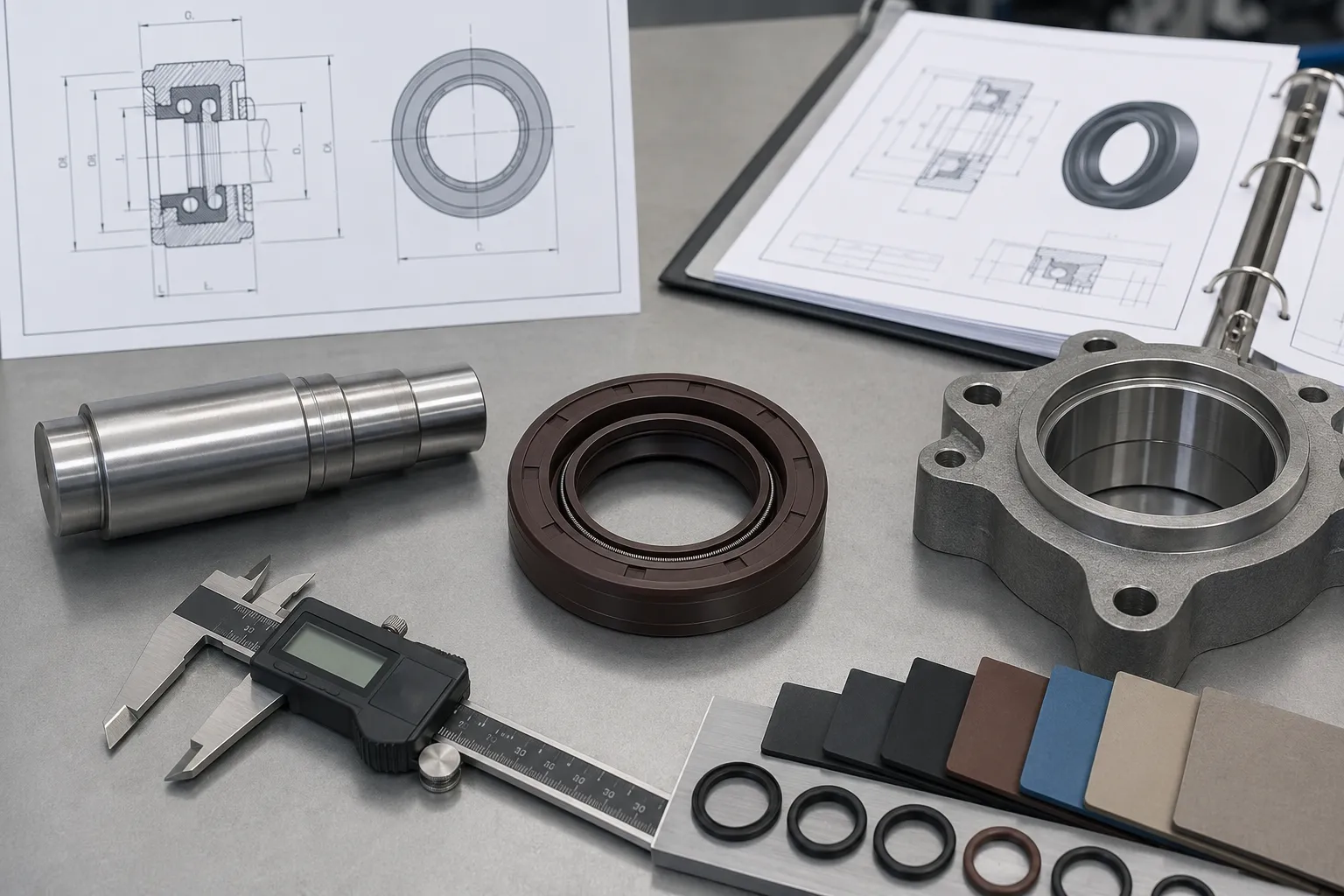
A reliable supplier should be able to explain the basic seal structure rather than only repeating a size code.
For common rotary oil seals, they should understand the difference between:
Single-lip and double-lip designs
Main sealing lip and auxiliary dust lip
Rubber-covered and metal outer diameter designs
Spring-loaded and non-spring-loaded lips
NBR, FKM, ACM, PTFE, and other material options
Standard seals and custom seals
Low-pressure and special pressure-capable designs
Standard rotary oil seals and heavy-duty cassette seals
For example, if you ask whether a TC or SC oil seal is more suitable for dusty agricultural machinery, the supplier should be able to explain that a TC seal typically has an additional dust lip for contamination protection.
If you ask whether NBR or FKM is better for a high-temperature engine oil application, the supplier should explain the difference in heat resistance, fluid compatibility, and cost.
A supplier that only asks for quantity and price without confirming the application may not be able to provide reliable technical support.
Evaluate Material Options Carefully
Material selection is one of the most important factors in oil seal performance.
A supplier should be able to explain which material is suitable for your operating conditions and why.
Common oil seal materials include:
Material | Typical Strengths | Common Applications |
|---|---|---|
NBR | Good resistance to many mineral oils and lubricants; cost-effective | General machinery, standard gearboxes, pumps, automotive applications |
ACM | Good resistance to heat and lubricating oils | Automotive engines and transmissions |
FKM | Strong heat resistance and fluid resistance | High-temperature engines, transmissions, synthetic oils, demanding machinery |
PTFE | Low friction and specialized high-performance sealing | High-speed, high-temperature, advanced sealing applications |
The supplier should not automatically recommend FKM for every application simply because it is more expensive.
In many standard applications, NBR may be the correct and economical choice. In higher-temperature, fuel-exposed, synthetic-oil, or demanding environments, FKM may offer better long-term performance.
Ask the supplier:
What material is used for this seal?
Is the material suitable for the actual fluid?
What is the recommended operating temperature range?
Is the seal suitable for continuous high-temperature operation?
Does the application require NBR, ACM, FKM, PTFE, or another material?
Can the supplier provide material information or technical documentation?
A good supplier should recommend the material based on the application, not only on what is currently in stock.
Review Product Quality and Consistency
Oil seal quality is not determined by appearance alone.
A seal may look acceptable from the outside while still having problems with lip molding, spring tension, rubber hardness, metal case fit, surface finish, or dimensional consistency.
When evaluating quality, check whether the supplier has a clear inspection process for:
Inner diameter
Outer diameter
Width
Lip shape
Spring installation
Rubber defects
Metal case defects
Surface finish
Material identification
Packaging condition
Batch consistency
For critical applications, request samples before placing a larger order.
Sample inspection should include:
Size verification
Lip condition
Spring position
Outer diameter design
Material confirmation
Product markings
Packaging quality
Fitment in the actual application
Initial leak testing where possible
A supplier should also be able to explain how they manage consistency between sample production and bulk production.
Ask for Product Drawings and Technical Information
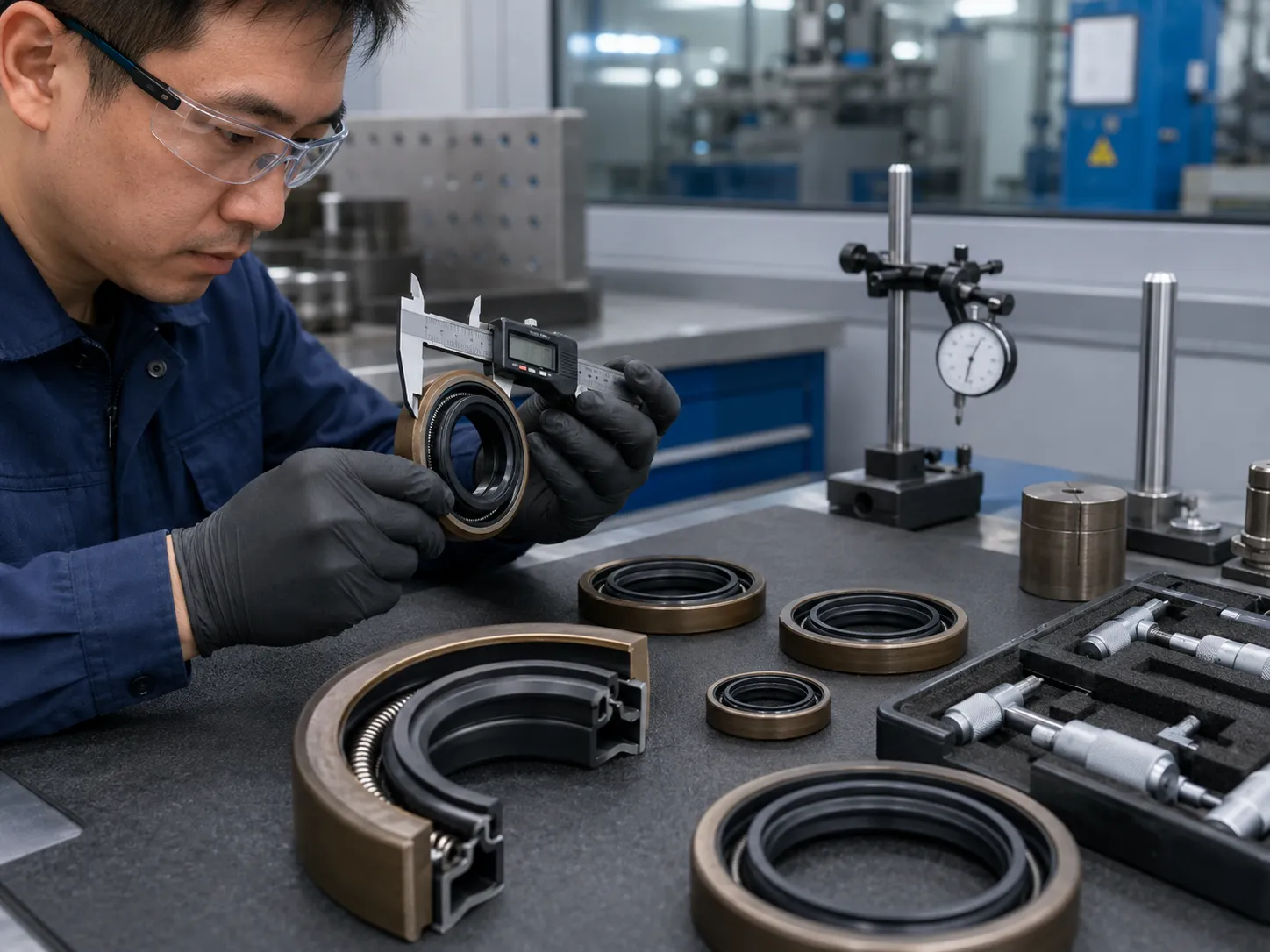
A reliable supplier should be able to provide basic technical information for the oil seal type being offered.
This does not mean every standard size requires a complex engineering drawing. However, for custom seals, unusual applications, special materials, or bulk purchasing, drawings and specifications are very useful.
Useful documents may include:
Product drawing
Size specification
Cross-section profile
Material description
Lip configuration
Temperature range reference
Application recommendation
Packaging specification
OEM cross-reference information
Inspection report, when applicable
Material or quality documentation, when available
A drawing can help confirm whether the seal has:
A single lip or double lip
A dust lip
A spring-loaded primary lip
A rubber-covered outer diameter
A metal outer diameter
A specific installation depth
A special profile or sealing edge
For custom projects, a drawing is often more reliable than a written description alone.
Confirm Manufacturing Capability and Supply Stability
A supplier does not need to own every production process to be reliable. Some companies specialize in manufacturing, while others combine inventory, sourcing, technical support, and logistics.
The key point is whether they can provide stable quality, reliable lead times, and clear product traceability.
Questions worth asking include:
Are the seals produced in-house or sourced from partner factories?
Which products are standard stock items?
Which products require custom production?
What is the normal lead time?
What is the sample lead time?
Can the supplier support repeat orders with the same specification?
How are production batches managed?
Can packaging, labels, or private marking be customized?
What happens if a requested size is not standard?
Can the supplier provide alternatives when a size is unavailable?
A supplier should answer these questions directly. Vague answers about lead time, stock, or production capability may create problems later.
Check Sample Support Before Placing a Large Order
Samples are especially important when:
The application is new
The original seal is unavailable
The size is non-standard
The material requirement is uncertain
The product will be used in a critical machine
The order quantity is large
The seal must match an OEM reference
The supplier is new to you
A useful sample process should include:
Confirming the exact size and seal type
Reviewing photos, drawings, or original samples
Confirming material options
Checking the lip structure and outer diameter design
Testing fitment in the actual application
Reviewing leakage or performance after initial operation
Confirming the final specification before bulk production
The sample should represent the final production specification as closely as possible.
Do not assume that a seal is correct only because it fits into the housing. A correct seal should also perform properly under actual temperature, lubricant, shaft speed, and pressure conditions.
Evaluate Communication Quality
Clear communication is one of the most practical signs of a reliable supplier.
A good supplier should be able to answer questions directly, confirm uncertain details, and explain when more information is needed.
Look for whether the supplier:
Responds clearly to technical questions
Asks for missing dimensions or application details
Provides drawings or photos when needed
Confirms material and seal type
Explains what is included in the quotation
States lead times clearly
Identifies potential fitment risks
Avoids making unrealistic performance promises
Provides updates if production or delivery changes
A supplier that immediately confirms every request without asking any technical questions may not be checking the application carefully.
For example, if you only provide a size and ask for a high-temperature oil seal, a reliable supplier should ask about the temperature, fluid type, shaft speed, and required material before recommending a product.
Compare More Than Unit Price
Unit price matters, but it should not be the only comparison point.
When comparing quotations, check:
Seal material
Seal type
Lip design
Outer diameter structure
Spring type
Product quality level
Packaging
Minimum order quantity
Sample cost
Lead time
Payment terms
Shipping terms
Customization options
Documentation availability
After-sales support
Replacement or claim process
A lower quote may be based on a different material, simpler lip design, reduced inspection level, or lower-quality packaging.
For example, one supplier may quote an NBR SC seal, while another may quote an FKM TC seal. They may have the same ID, OD, and width, but they are not equivalent products.
Always compare the complete specification before comparing prices.
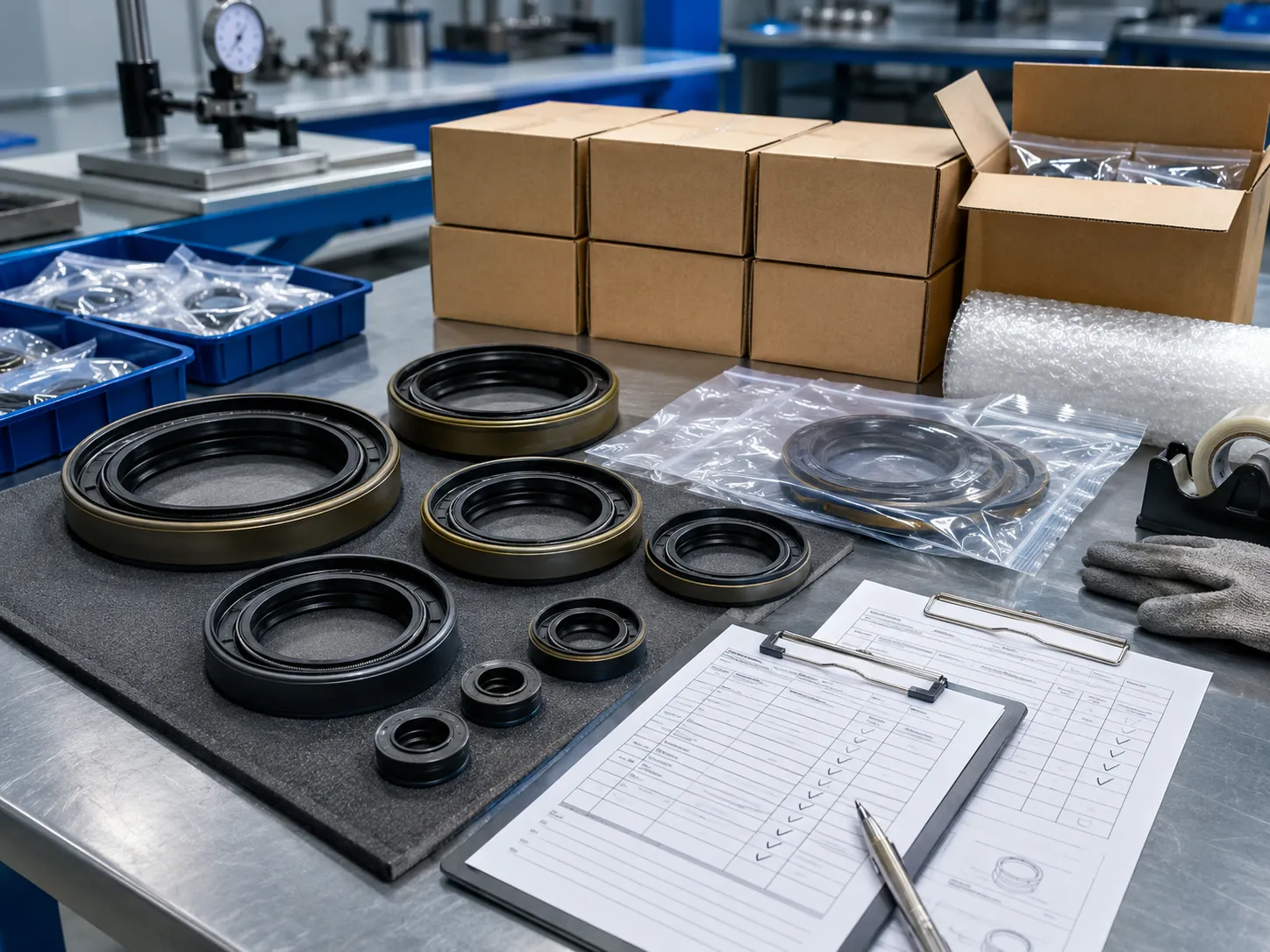
Check Packaging, Labeling, and Traceability
Packaging is often overlooked, but it matters for both product protection and inventory management.
Poor packaging can lead to damaged sealing lips, distorted springs, contaminated rubber, or mixed product sizes during storage and transport.
A reliable supplier should be able to explain:
How seals are packed
Whether each size is separately labeled
Whether material and type codes are shown
How different batches are identified
Whether private labels are available
Whether cartons are suitable for long-distance shipping
Whether packaging can be customized for your market
For repeat orders, clear labels and batch information make it easier to manage inventory and identify products if a quality issue occurs later.
Verify Delivery and Order Management
Delivery reliability is as important as product quality, especially when the seals are needed for maintenance schedules, production lines, or customer orders.
Before placing an order, confirm:
Standard lead time
Custom production lead time
Sample delivery time
Available shipping methods
Export packaging
Incoterms
Freight responsibilities
Document requirements
Whether partial shipments are possible
How order progress will be communicated
How delays will be handled
A reliable supplier should not promise unrealistic delivery dates just to win the order.
It is better to receive a realistic lead time than a fast promise followed by repeated delays.
Understand the Supplier’s Quality Claim Process
Even good suppliers can encounter quality issues. What matters is how the supplier handles them.
Before placing a larger order, ask:
What happens if the delivered size is incorrect?
What happens if the seal material does not match the approved sample?
How should a product issue be documented?
Is photo evidence required?
Are samples or defective products needed for analysis?
Can the supplier provide replacement products?
Can the supplier issue a credit or other solution?
How are repeat issues prevented?
A reliable supplier should have a reasonable process for reviewing problems rather than avoiding responsibility.
For critical applications, agree on the product specification, approval sample, inspection method, and claim process before production begins.
When Should You Consider a Custom Oil Seal?
A standard oil seal may not be suitable for every application.
Custom oil seals may be needed when:
The required ID, OD, or width is non-standard
The shaft or housing has unusual geometry
The seal must operate at high temperature
The application uses special fluids
The shaft surface has a unique design
The seal needs a special lip profile
The equipment operates under unusual pressure
The original seal is discontinued
A private label or special packaging is required
The application needs a drawing-based replacement
For custom seals, the supplier should request detailed information rather than simply offering the nearest standard size.
Useful information includes:
Technical drawing
Original sample
Shaft diameter
Housing bore diameter
Width
Shaft speed
Fluid type
Operating temperature
Pressure level
Machine model
OEM reference
Photos of the installation position
A Practical Supplier Evaluation Checklist
Before placing an order, review the supplier using the following checklist:
Evaluation Area | Questions to Ask |
Product knowledge | Can the supplier explain the seal type, material, lip design, and application suitability? |
Technical support | Do they ask for shaft, housing, fluid, temperature, and application information? |
Material options | Can they explain NBR, FKM, ACM, PTFE, and other available choices? |
Product quality | Do they have a process for checking dimensions, lip quality, springs, and batch consistency? |
Samples | Can they provide samples for fitment and performance verification? |
Drawings and documentation | Can they provide product drawings, specifications, or technical information when needed? |
Production capability | Can they support standard stock, repeat orders, or custom production? |
Communication | Are quotations, technical answers, lead times, and product details clear? |
Packaging | Are seals protected, labeled, and organized by size and batch? |
Delivery | Are lead times, shipping methods, and export requirements clearly explained? |
Issue handling | Do they have a clear process for reviewing incorrect or defective products? |
A supplier does not need to be perfect in every area, but they should be transparent about what they can provide and where additional confirmation is needed.
Conclusion
A reliable oil seal supplier should offer more than a low price and a standard size list.
The right supplier should understand oil seal structure, confirm ID, OD, width, material, lip design, and application conditions. They should support samples, provide clear technical information, maintain consistent quality, communicate honestly about lead times, and handle issues responsibly.
Before placing an order, compare the complete specification rather than only the price. Check the material, seal type, quality process, sample support, packaging, delivery reliability, and communication quality.
A careful supplier evaluation process can reduce the risk of incorrect fitment, repeat leakage, delayed delivery, and unnecessary maintenance costs.
SealVendor supports standard and custom oil seal selection based on dimensions, original samples, technical drawings, OEM references, material requirements, and application conditions.