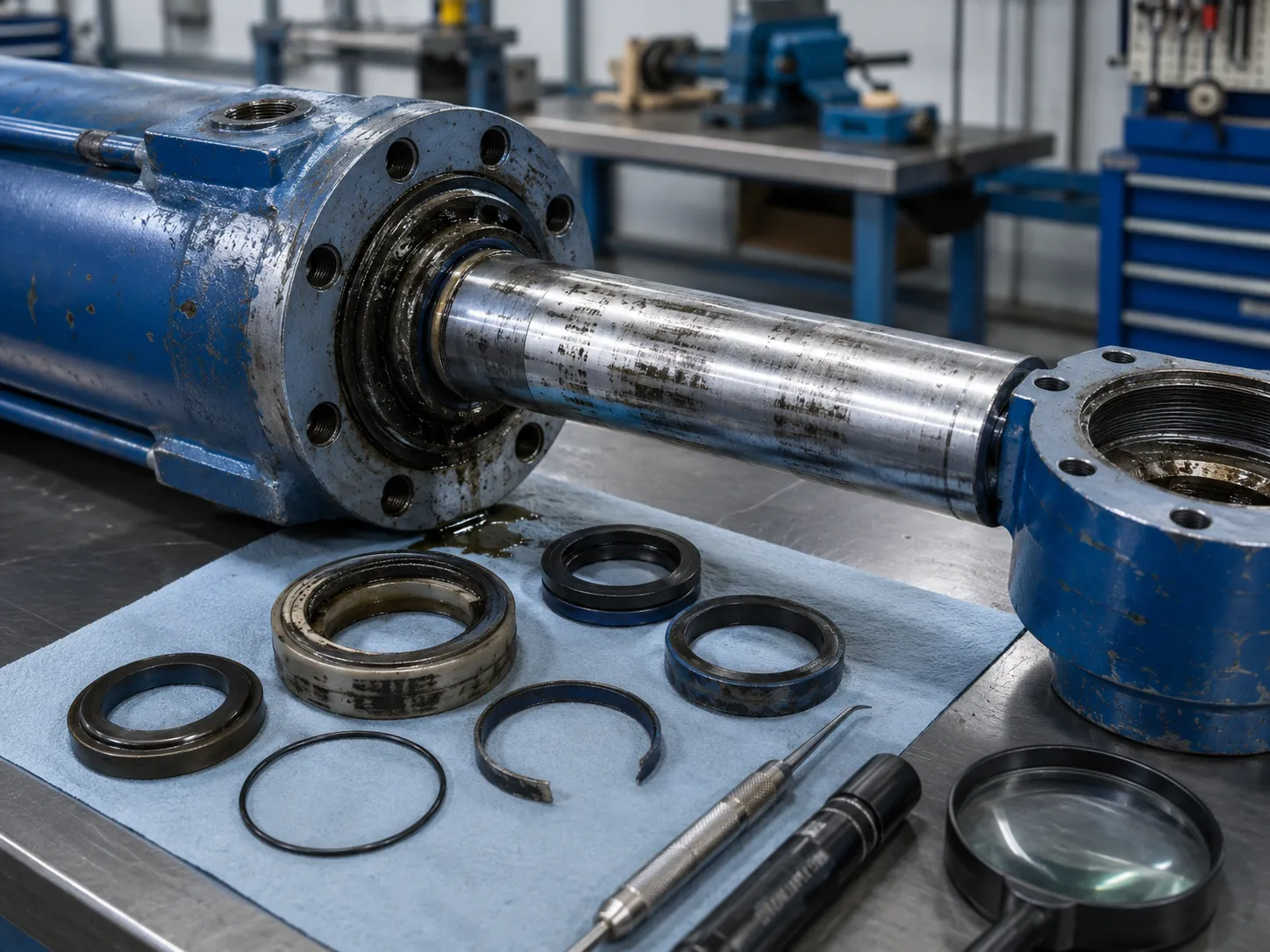
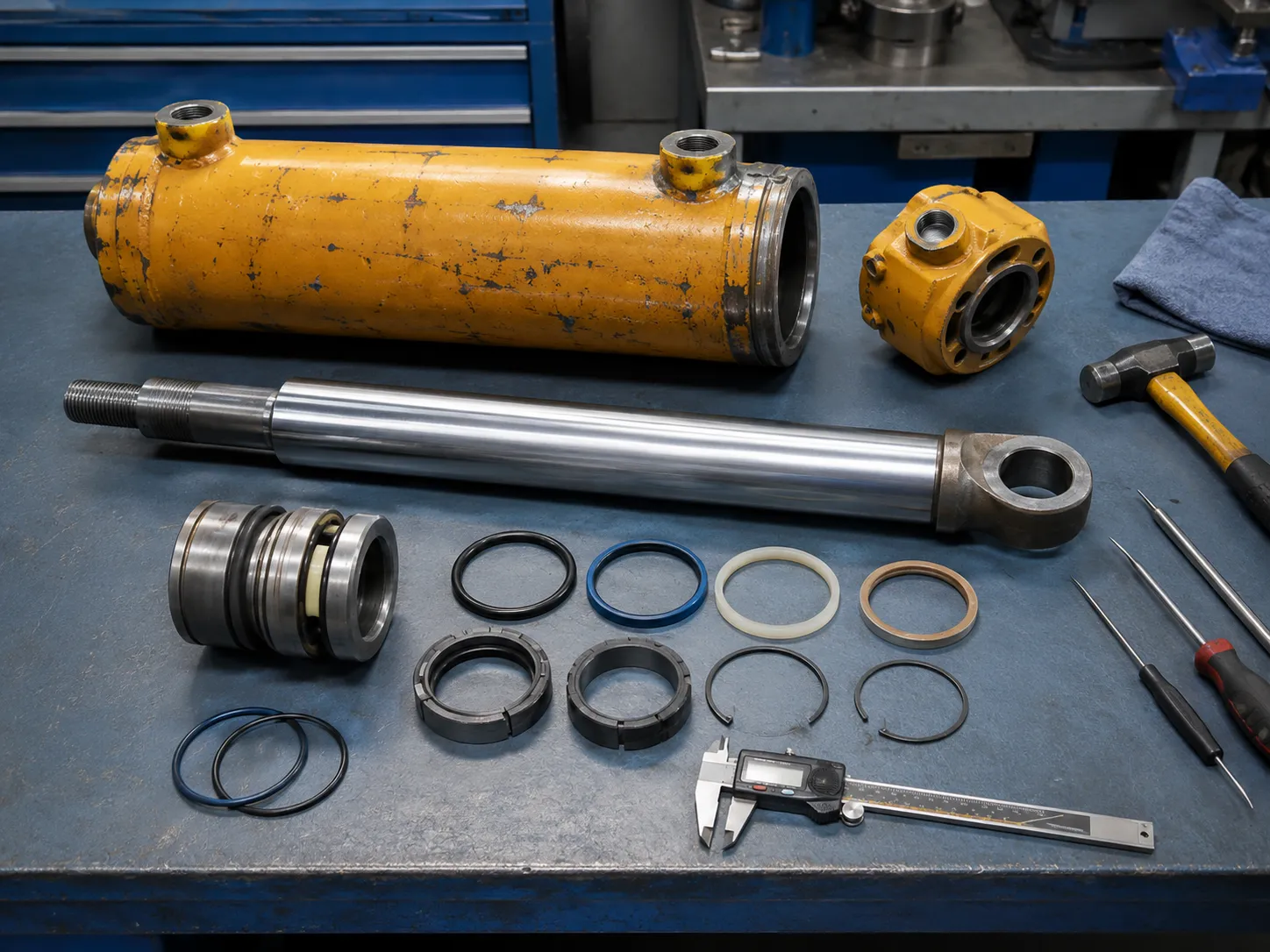
Hydraulic cylinder seal replacement cost can range from a relatively straightforward reseal to a major repair involving rod restoration, bore work, machining, testing, transport, or full cylinder replacement.
The seal kit itself is often only one part of the total cost.
A hydraulic cylinder may contain rod seals, piston seals, wipers, buffer seals, guide rings, wear bands, O-rings, backup rings, and static seals. Replacing these components can be economical when the piston rod, cylinder bore, gland, piston, guide components, and hydraulic fluid are still in good condition.
However, the cost increases quickly when the cylinder has a scored rod, damaged chrome surface, bent rod, worn bore, excessive side loading, damaged gland, failed guide rings, contaminated fluid, or internal mechanical damage.
For industrial and mobile equipment, the largest cost may not always be the repair invoice. Machine downtime, field-service access, transport, lifting requirements, production delays, and emergency repair work can have a much greater impact than the seal kit itself.
This guide explains what affects hydraulic cylinder seal replacement cost, when a simple reseal may be enough, when additional repair is necessary, and what information should be confirmed before requesting a quote.
Why Hydraulic Cylinder Seal Replacement Costs Vary So Much
Two hydraulic cylinders may use similar seal kits but have completely different repair costs.
A small cylinder removed from accessible equipment may be repaired on a bench with limited disassembly. A large boom cylinder, press cylinder, marine cylinder, mining cylinder, or industrial actuator may require lifting equipment, machine shutdown, hydraulic line isolation, transport, special tooling, and pressure testing before it can return to service.
The final cost usually depends on five main areas:
Cylinder size and construction
Access and removal difficulty
Seal-kit type and material
Condition of the rod, bore, piston, gland, and guide components
Repair, testing, transport, and downtime requirements
The most important point is simple: a leaking hydraulic cylinder does not always need the same level of repair.
A cylinder with clean fluid, an undamaged rod, a smooth bore, stable guide components, and normal alignment may only need a reseal.
A cylinder with rod scoring, corrosion, side loading, damaged guides, bore wear, or internal contamination may need more than a new seal kit.
What Does a Hydraulic Cylinder Seal Replacement Estimate Include?
A complete hydraulic cylinder repair estimate may include several separate costs.
Cost Area | What It May Include |
|---|---|
Inspection and diagnosis | Leak assessment, rod inspection, bore inspection, seal failure analysis, measurement checks |
Cylinder removal | Machine access, hydraulic line isolation, lifting, transport, disconnection of pins or mounting hardware |
Disassembly | Gland removal, piston removal, cleaning, seal removal, inspection of internal components |
Seal kit | Rod seal, piston seal, wiper, buffer seal, O-rings, backup rings, guide rings, wear bands |
Material selection | Standard or upgraded materials based on fluid, temperature, pressure, speed, and environment |
Rod repair | Polishing, grinding, re-chroming, replacement, or repair of damaged threads and rod ends |
Bore repair | Honing, polishing, machining, tube replacement, or cylinder barrel repair |
Hardware repair | Gland repair, piston repair, guide-ring replacement, pin and bushing work, mount repair |
Hydraulic fluid service | Fluid top-up, fluid replacement, filter replacement, flushing, contamination control |
Reassembly and testing | Correct installation, pressure testing, leak testing, stroke testing, final inspection |
Logistics and downtime | Transport, field service, lifting equipment, emergency work, production interruption |
The seal kit is only one line in the estimate.
For a cylinder with no mechanical damage, the kit and labor may be the main cost. For a damaged cylinder, rod and bore repair can become more expensive than the seals themselves.
Typical Cost Levels: Reseal, Repair, Rebuild, or Replace
Instead of relying on one universal price, it is more useful to compare the repair level.
Repair Level | Typical Condition | Work Usually Required | Relative Cost |
Reseal | Rod, bore, and major components remain usable | Disassembly, seal-kit replacement, cleaning, reassembly, testing | Lowest |
Repair | Light rod damage, worn guides, minor gland or bore issues | Reseal plus rod polishing, guide replacement, minor machining, local repairs | Moderate |
Rebuild | Significant rod, bore, piston, gland, or structural wear | Major component repair, replacement of damaged parts, extensive inspection and testing | Higher |
Exchange or replacement | Cylinder is severely damaged, obsolete, unsafe, or uneconomical to rebuild | Remanufactured, new, or replacement cylinder assembly | Highest initial cost, but may reduce downtime |
Reseal Cost
A reseal is usually the lowest-cost option when the cylinder hardware remains in acceptable condition.
A typical reseal may include:
Rod seal replacement
Piston seal replacement
Wiper replacement
Static O-ring replacement
Backup-ring replacement
Guide-ring or wear-band inspection
Cleaning of internal parts
Reassembly
Basic leak and function testing
Resealing is often suitable when:
External leakage is present but limited
The piston rod is smooth and undamaged
The cylinder bore has no major scoring
Guide rings are still within usable condition
The cylinder is correctly aligned
Hydraulic fluid is clean
The cylinder has no major internal damage
The rod is not bent
The gland and piston are in good condition
A reseal may be economical, but it should not be treated as an automatic solution. Installing a new seal kit over a damaged rod or scored bore can create another leak shortly after the cylinder returns to service.
Repair Cost
Repair becomes necessary when the cylinder has light to moderate component damage but still has reusable major parts.
This may include:
Piston rod polishing
Minor rod surface repair
Replacement guide rings
Replacement wear bands
Gland repair
Piston repair
Minor bore polishing or honing
Replacement of damaged O-rings and backup rings
Thread repair
Pin or bushing replacement
Cleaning after limited contamination
Seal upgrade for a more demanding application
A repair-level job may cost more than a simple reseal, but it can be more economical than allowing a damaged rod or bore to destroy another seal kit.
Rebuild Cost
A rebuild is normally considered when damage is more serious or when the cylinder has accumulated substantial service wear.
A rebuild may involve:
Rod re-chroming or rod replacement
Cylinder bore repair or replacement
Gland replacement
Piston replacement
Guide-ring and wear-band replacement
New seal kit
Internal cleaning and contamination control
Repair of damaged rod ends
Replacement of pins, bushings, or mounting components
Pressure testing
Stroke testing
Paint, corrosion protection, or external restoration where required
Rebuild cost is influenced by the availability of replacement components, machining requirements, cylinder size, and the amount of disassembly involved.
A large or custom cylinder may be worth rebuilding because replacement lead time and equipment downtime could be significant.
Exchange or Replacement Cost
Full replacement may be the better option when the cylinder is severely damaged, unsafe to repair, obsolete, repeatedly failing, or too costly to rebuild.
Replacement may involve:
New hydraulic cylinder
Remanufactured cylinder
Exchange cylinder
OEM replacement assembly
Drawing-based custom cylinder
New mounting hardware
New pins or bushings
Hydraulic hose or fitting replacement
Installation and setup
Function testing after installation
A new or remanufactured cylinder can have a higher initial cost, but it may reduce risk when the old cylinder has deep bore damage, severe corrosion, major structural damage, repeated seal failures, or uncertain repair history.
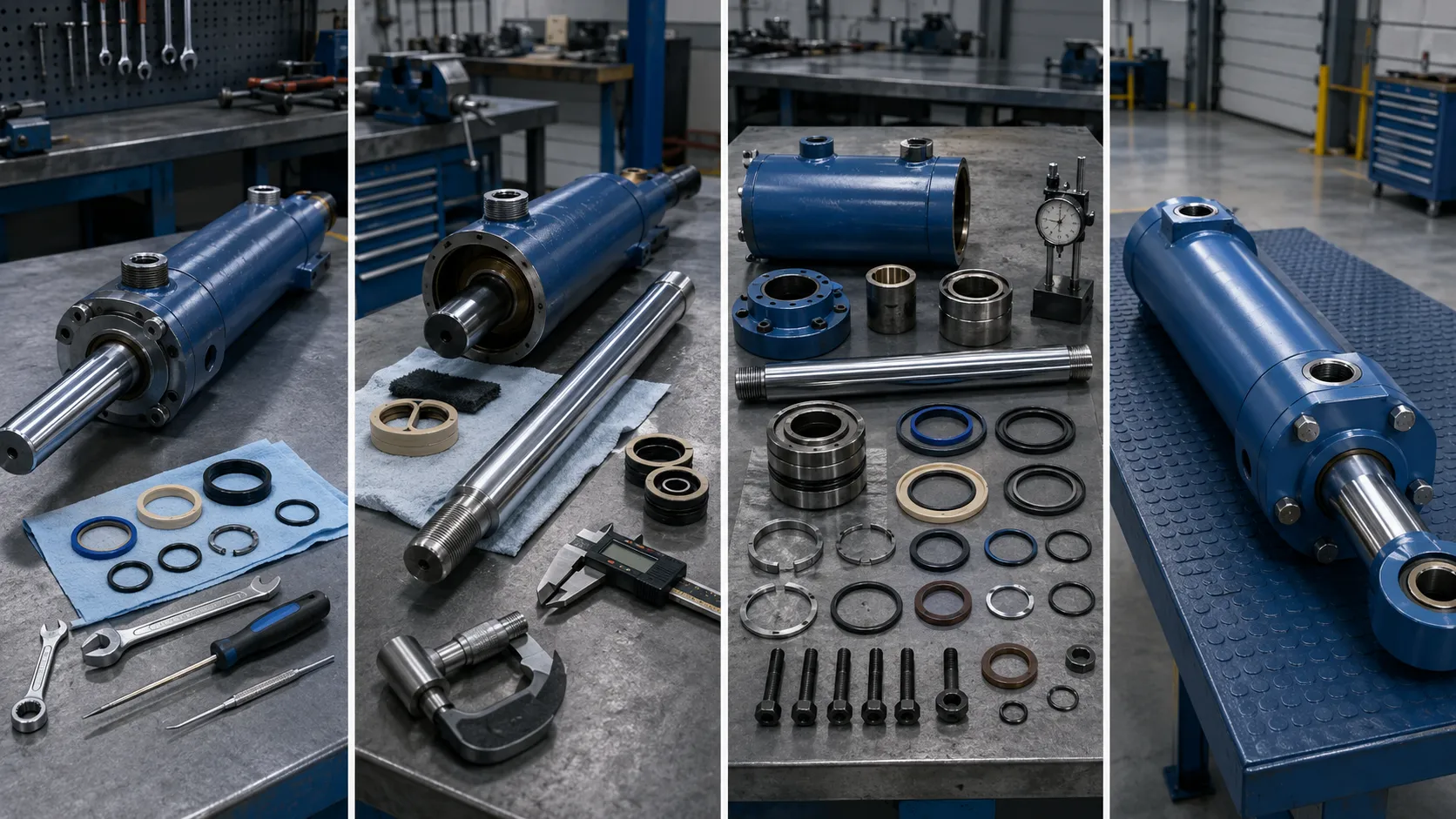
What Is Included in a Hydraulic Seal Kit?
A hydraulic cylinder seal kit may contain different components depending on the cylinder design.
Common items include:
Rod seal
Piston seal
Wiper or scraper seal
Buffer seal
Static O-ring
Backup ring
Guide ring
Wear ring
Bearing strip
Piston wear band
Gland seal
Port O-rings
Anti-extrusion elements
Retaining rings in selected cylinder designs
Not every cylinder uses every item listed above.
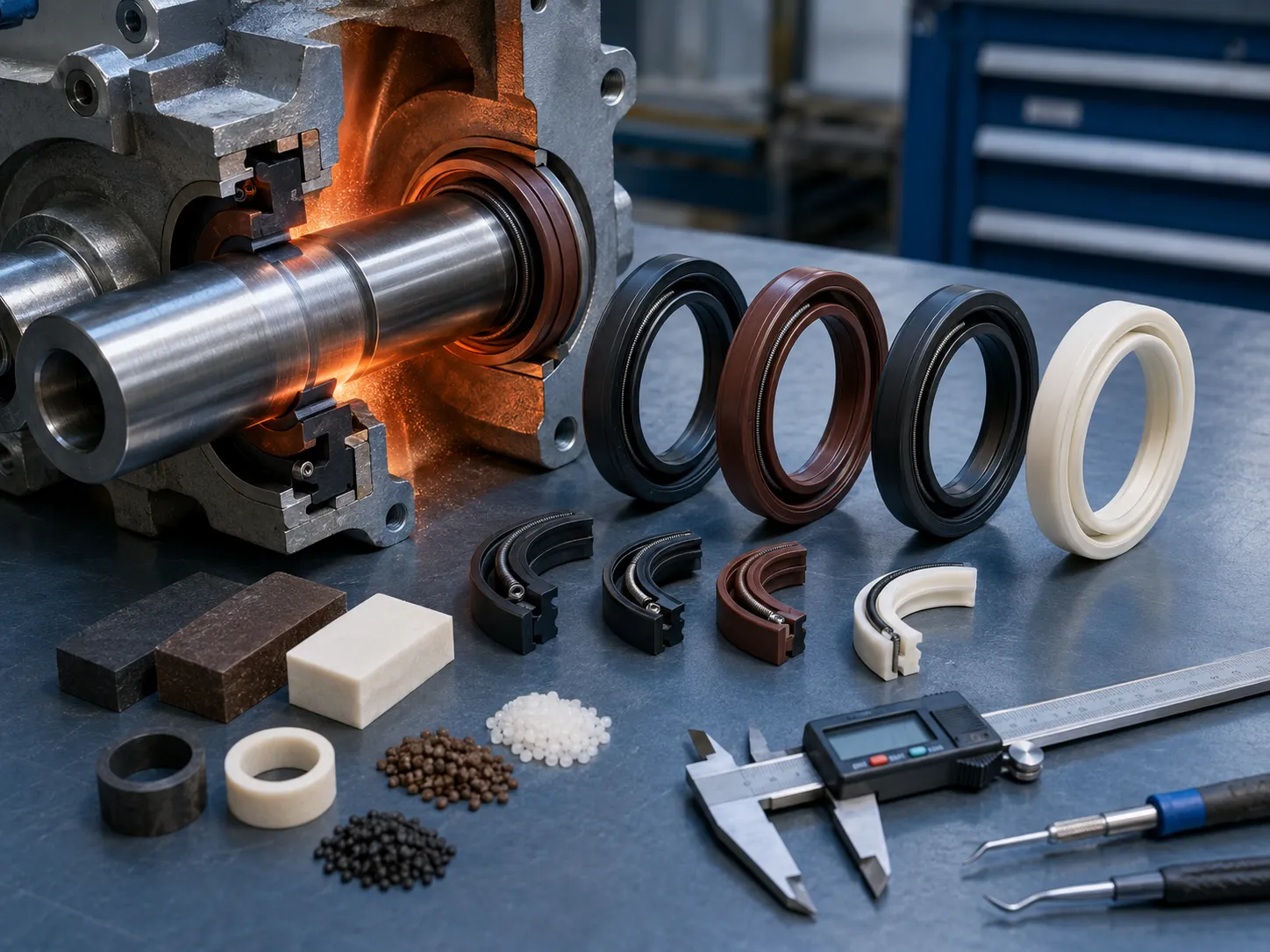
For example, one cylinder may use a polyurethane rod seal, PTFE guide rings, a double-lip wiper, and a nitrile O-ring. Another may use a fabric-reinforced piston seal, a buffer seal, a different wiper profile, multiple backup rings, and special guide elements for high-pressure or heavy-load service.
This is why a seal kit should not be selected only by bore diameter or rod diameter.
The correct kit should match the cylinder design, groove dimensions, hydraulic fluid, pressure, operating temperature, speed, and working environment.
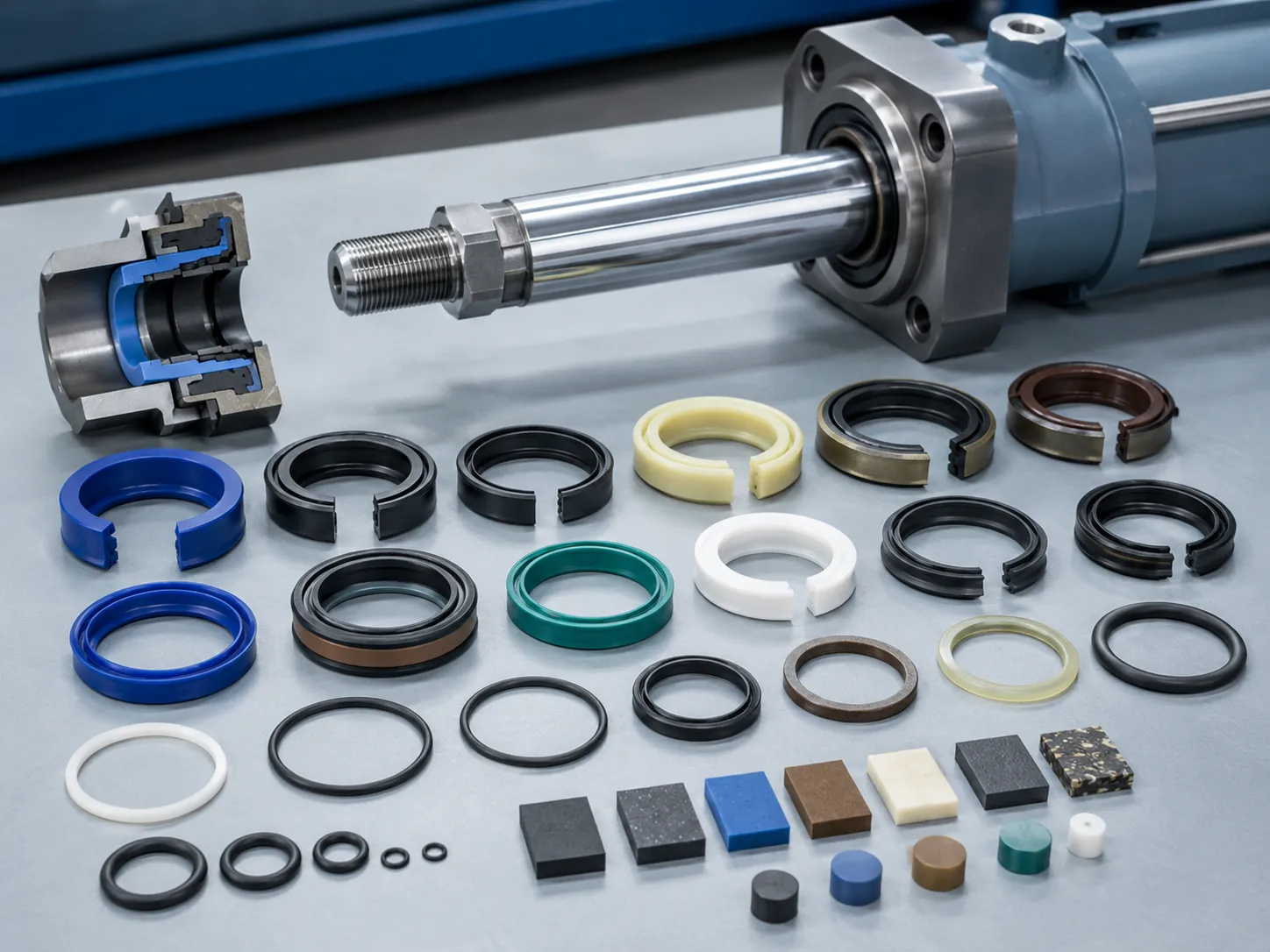
How Seal Material Affects Hydraulic Cylinder Repair Cost
Seal material can affect the part cost, but it should be selected based on operating conditions rather than price alone.
A lower-cost seal material may work well in a clean, moderate-temperature mineral-oil hydraulic system. A more demanding application may require higher-performance elastomers or engineered materials to resist pressure, heat, fluid exposure, wear, or extrusion.
Common material considerations include:
Material or Material Group | Typical Use Considerations |
NBR | Often used in standard mineral-oil hydraulic systems and general-purpose sealing applications |
Polyurethane | Common for wear-resistant rod and piston seal applications, especially where abrasion resistance is important |
HNBR | Used in selected higher-temperature or more demanding fluid applications |
FKM | Used where temperature or fluid resistance requirements are more demanding |
PTFE | Used in selected low-friction, high-speed, high-temperature, or specialized fluid applications |
POM or engineered thermoplastics | Often used for guide rings, backup rings, anti-extrusion parts, and wear components |
Fabric-reinforced materials | Used in certain heavy-duty piston sealing applications |
Material selection should consider:
Hydraulic fluid type
Mineral oil, synthetic fluid, water-glycol fluid, or another special fluid
Operating temperature
Cold-start temperature
Maximum pressure
Pressure spikes
Rod speed
Cycle frequency
Contamination exposure
Outdoor weather exposure
Chemical exposure
Required service life
Seal profile and hardware clearance
Using a more expensive material does not automatically create a better repair.
For example, a high-temperature material may not solve a side-loading problem. A high-pressure seal profile may not solve a deeply scored rod. A premium seal kit can still fail early if the cylinder bore, rod surface, guide components, and hydraulic fluid condition are not addressed.
What Drives Labor Cost in Hydraulic Cylinder Repair?
Labor is often the largest part of hydraulic cylinder repair cost, especially for heavy equipment and industrial applications.
The most common labor-related cost factors include:
Cylinder Access and Removal
A cylinder installed on a bench, compact machine, or easily accessible actuator may be removed with limited labor.
A boom cylinder, lift cylinder, steering cylinder, press cylinder, marine cylinder, or large industrial actuator may require:
Machine shutdown
Load support
Hydraulic pressure release
Hose removal
Pin removal
Lifting equipment
Access platforms
Guard removal
Transport from the machine to the repair area
Reinstallation and alignment after repair
The more difficult it is to remove and reinstall the cylinder, the more labor is involved.
Cylinder Size and Weight
Larger cylinders typically require more handling equipment, larger repair stands, additional labor, and more time for disassembly and reassembly.
Heavy cylinders may need:
Cranes
Forklifts
Hoists
Lifting straps
Special stands
Large spanner tools
Torque equipment
Custom fixtures
Safer transport arrangements
A small cylinder may be serviced by one technician. A large cylinder may require multiple technicians and lifting support.
Internal Construction
Some hydraulic cylinders have relatively straightforward gland and piston arrangements.
Others may use:
Large retaining rings
Threaded glands
Deep internal grooves
High-pressure seal profiles
Multiple guide elements
Special piston designs
Buffer seals
Large-diameter rods
Heavy-duty wear bands
Complex mounting arrangements
Custom or non-standard seal grooves
More complex cylinder construction can increase inspection time, installation difficulty, and testing requirements.
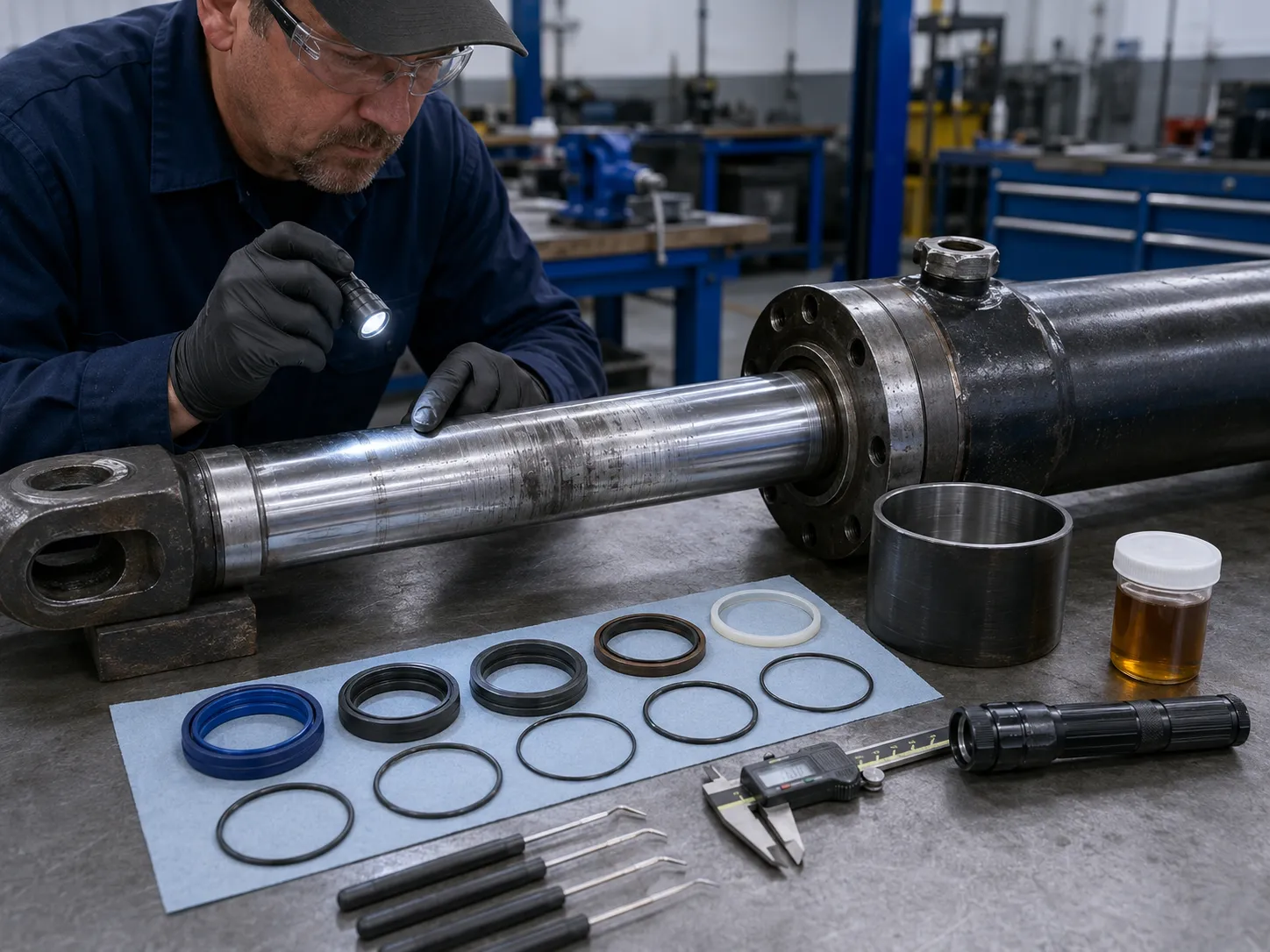
Damage Assessment and Measurement
A leaking cylinder should be inspected before a final repair scope is confirmed.
Additional labor may be needed to measure:
Rod diameter
Bore diameter
Rod straightness
Rod surface damage
Bore scoring
Gland condition
Piston condition
Groove dimensions
Guide-ring wear
Mounting wear
Pin and bushing condition
Seal contact surfaces
Rod-end damage
This inspection time helps prevent incomplete repairs and repeat failures.
Cleaning and Contamination Control
Hydraulic systems are sensitive to contamination.
A proper repair may require cleaning of:
Cylinder barrel
Piston
Gland
Rod
Seal grooves
Ports
Hydraulic lines
Hose connections
Repair tools
Work area
Fluid sample points
If contamination is found, the repair may also require filter service, fluid replacement, system flushing, or inspection of related components.
Common Additional Repairs That Increase the Final Cost
A seal kit replacement may reveal related damage that affects the final estimate.
Common additional items include:
Rod polishing
Rod re-chroming
Rod replacement
Bore honing
Cylinder tube repair
Cylinder barrel replacement
Gland replacement
Piston replacement
Guide-ring replacement
Wear-band replacement
Buffer-seal upgrade
Wiper upgrade
Thread repair
Rod-end repair
Pin replacement
Bushing replacement
Mounting repair
Hose replacement
Fitting replacement
Hydraulic fluid replacement
Filter replacement
System flushing
Pressure testing
Leak testing
Field-service travel
Machine downtime support
Not every item should be replaced automatically.
A repair provider should explain whether the added work is necessary because of damage, contamination, safety, wear limits, application conditions, or access while the cylinder is already disassembled.
When Is a Simple Reseal Usually Enough?
A simple reseal may be a reasonable option when the cylinder has external leakage but the hardware remains in good condition.
Typical signs that resealing may be enough include:
Rod surface is smooth
No deep scratches or pitting are present
Chrome surface is intact
Bore has no major scoring
Rod is straight
Guide rings are not heavily worn
Gland is undamaged
Piston is undamaged
Hydraulic fluid is clean
Wiper is functioning correctly
Cylinder alignment is normal
No severe pressure spikes are present
No major internal drift or holding issue is present
The seal failure is consistent with normal service wear
Even in these cases, the cylinder should be cleaned, inspected, and tested before being returned to service.
A reseal should not be used as a shortcut when deeper damage is visible.
When Does the Repair Need More Than a Seal Kit?
A seal kit alone is usually not enough when the cylinder has mechanical damage or a system-level problem.
Additional repair should be considered when there is:
Deep piston rod scoring
Corrosion or pitting in the rod sealing area
Peeling or damaged chrome
Bent piston rod
Damaged rod threads
Scored cylinder bore
Worn piston or gland
Excessive guide-ring wear
Side loading
Loose mounting pins
Worn bushings
Repeated rod seal failure
Severe fluid contamination
Seal extrusion
Pressure-related seal damage
Damaged wiper and dirt ingress
Cylinder drift caused by internal bypass
Leakage shortly after a previous repair
A new rod seal cannot create a reliable sealing surface on a damaged rod.
A new piston seal cannot correct a heavily scored bore.
A new seal kit cannot correct severe side loading, pressure spikes, excessive clearance, incorrect hydraulic fluid, or a blocked contamination-control system.
Reseal, Repair, Rebuild, or Replace: How to Decide
The best decision depends on the condition of the cylinder and the operating needs of the equipment.
Condition | Likely Best Option |
Light external leakage, rod and bore undamaged | Reseal |
Minor rod scratches, worn wiper, light guide wear | Repair plus reseal |
Rod corrosion, damaged chrome, bore wear, internal damage | Rebuild |
Severe structural damage, obsolete design, repeated failure, high repair cost | Replace or exchange |
Safety-critical lifting or holding application with uncertain cylinder condition | Professional inspection before repair decision |
Frequent failure caused by machine alignment or contamination | Correct root cause before reseal or rebuild |
The cheapest repair is not always the lowest long-term cost.
A low-cost reseal can become expensive when the same cylinder fails again because rod damage, guide wear, contamination, or alignment problems were ignored.
How Downtime Changes the Real Cost of Hydraulic Cylinder Repair
For industrial and mobile equipment, downtime can be more expensive than the cylinder repair itself.
A seal kit may be inexpensive, but the real impact can include:
Equipment shutdown
Delayed production
Lost machine availability
Emergency labor
Missed project deadlines
Rental equipment
Field-service travel
Overtime
Delayed maintenance schedules
Operator downtime
Secondary damage caused by running with low fluid or internal leakage
A lower-cost seal kit is not always the best choice when a cylinder operates in high-cycle, heavy-load, remote, or safety-critical service.
In these situations, the repair decision should consider:
Expected service life
Material compatibility
Rod condition
Bore condition
Guide component condition
Seal design
Repair turnaround time
Availability of replacement parts
Consequences of repeat failure
How to Get an Accurate Hydraulic Cylinder Seal Replacement Quote
A useful quote should be based on more than a photo of an external leak.
Before requesting a quote, provide as much of the following information as possible:
Cylinder manufacturer
Cylinder model or part number
Equipment make and model
Cylinder application
Bore diameter
Rod diameter
Stroke length
Retracted and extended length
Mounting style
Existing seal kit number
Original seal sample
Photos of the cylinder
Photos of the leak area
Photos of rod damage, corrosion, or scoring
Hydraulic fluid type
Operating temperature
Maximum pressure
Machine duty cycle
Exposure to dust, mud, water, heat, chemicals, or salt
Whether the cylinder drifts under load
Whether movement is slow or uneven
Whether leakage returned after a previous repair
Whether pins, bushings, or mounts have excessive play
Whether the cylinder must be repaired on-site
Required completion date
A good repair quote should clearly show:
Inspection charge, if applicable
Seal kit type
Material recommendation
Labor scope
Rod or bore repair scope
Additional parts
Fluid or filter requirements
Pressure-testing scope
Transport or field-service costs
Estimated turnaround time
Warranty terms
Exclusions and possible additional damage findings
The quote should also explain whether the price is for a reseal only, a repair, a rebuild, or a replacement cylinder.
How to Avoid Paying Twice for the Same Hydraulic Seal Failure
Repeat seal failure often happens when only the visible leak is repaired.
Before installing a new hydraulic seal kit, inspect:
Piston rod surface
Cylinder bore condition
Gland condition
Piston condition
Guide rings and wear bands
Wiper condition
Hydraulic fluid cleanliness
Filter condition
Breather condition
Cylinder alignment
Mounting pins and bushings
Side loading
Rod straightness
Pressure spikes
Relief valve condition
Fluid type
Operating temperature
Correct seal material
Correct seal profile
Groove dimensions
Backup-ring requirement
Installation procedure
The goal is not simply to stop the visible leak.
The goal is to restore a stable sealing environment so the replacement seals can operate correctly.
How to Choose the Right Replacement Hydraulic Seal Kit
A replacement kit should match the real cylinder design and operating conditions.
Before ordering, confirm:
Rod diameter
Cylinder bore diameter
Piston dimensions
Gland dimensions
Seal groove sizes
Seal profile
Rod seal type
Piston seal type
Wiper type
Buffer seal requirement
Static seal requirement
Guide-ring material
Backup-ring requirement
Hydraulic fluid type
Operating temperature
Maximum pressure
Rod speed
Application environment
Existing seal sample
Original part number
Cylinder manufacturer or drawing reference
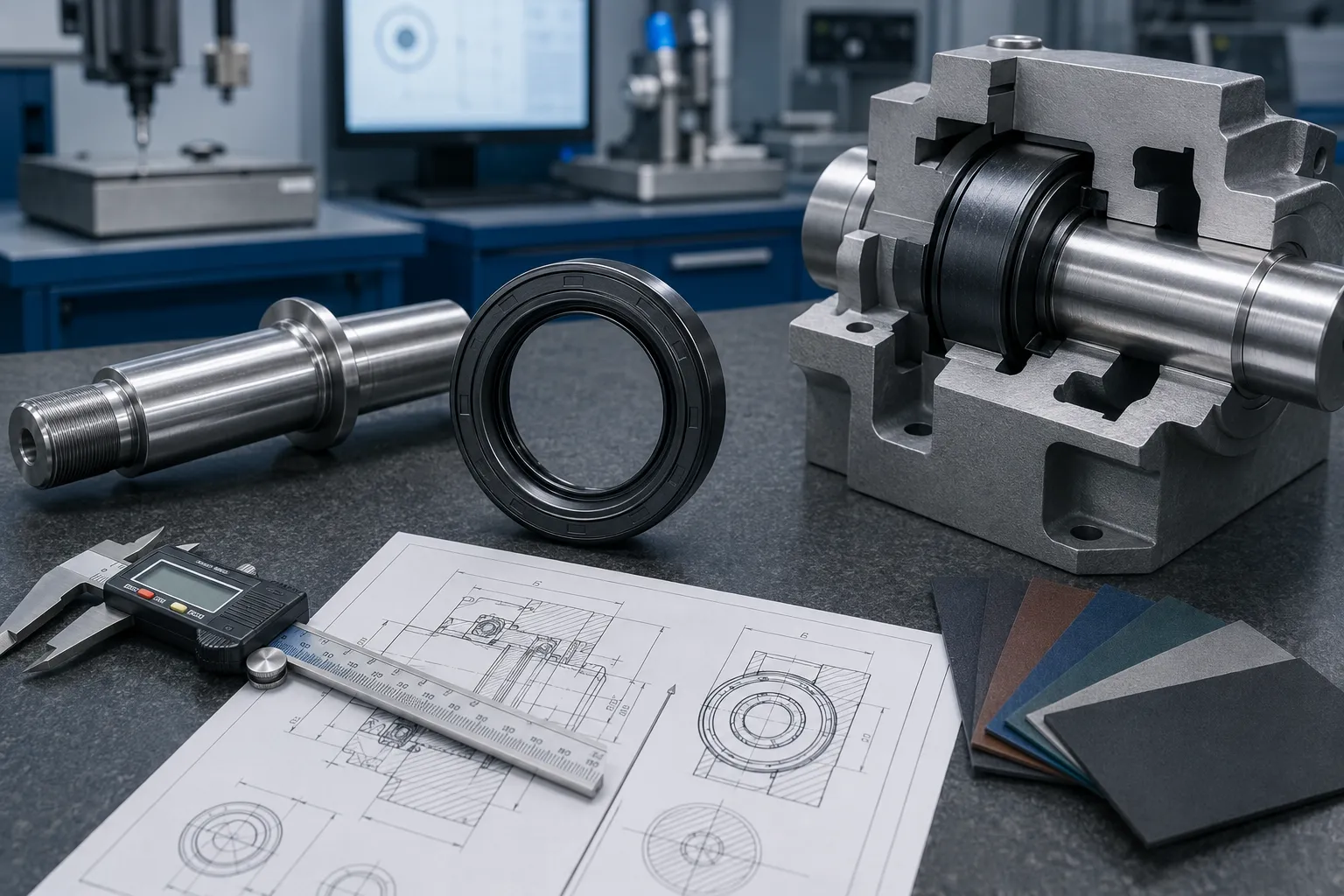
Two cylinders with similar rod and bore dimensions may use different seals because their groove dimensions, pressure levels, materials, piston arrangements, and application conditions are different.
For non-standard cylinders, a complete seal sample, gland drawing, piston drawing, or dimensional inspection may be necessary.
Conclusion
Hydraulic cylinder seal replacement cost depends on more than the price of a seal kit.
A basic reseal can be the most economical option when the rod, bore, gland, piston, guides, alignment, and hydraulic fluid are still in good condition.
The cost increases when the repair requires rod restoration, bore work, guide-ring replacement, contamination control, pressure testing, transport, field service, or full cylinder replacement.
The most reliable approach is to identify the repair level first: reseal, repair, rebuild, or replace.
Before approving work, confirm the cylinder condition, root cause of the leak, seal-kit specification, material compatibility, required additional repairs, testing scope, turnaround time, and the risk of repeat failure.
SealVendor supports hydraulic rod seals, piston seals, wipers, buffer seals, guide rings, backup rings, hydraulic seal kits, material matching, sample-based identification, and drawing-based custom sealing requirements.